
Introduction
A Subway salad can be a filling meal, but the Subway Salad Calories & Nutrition Guide depends on the meat, cheese, vegetables, toppings, and sauce you choose. A basic salad can be much lighter than a sandwich, while cheese, avocado, bacon, and creamy sauces can raise the calorie count quickly.
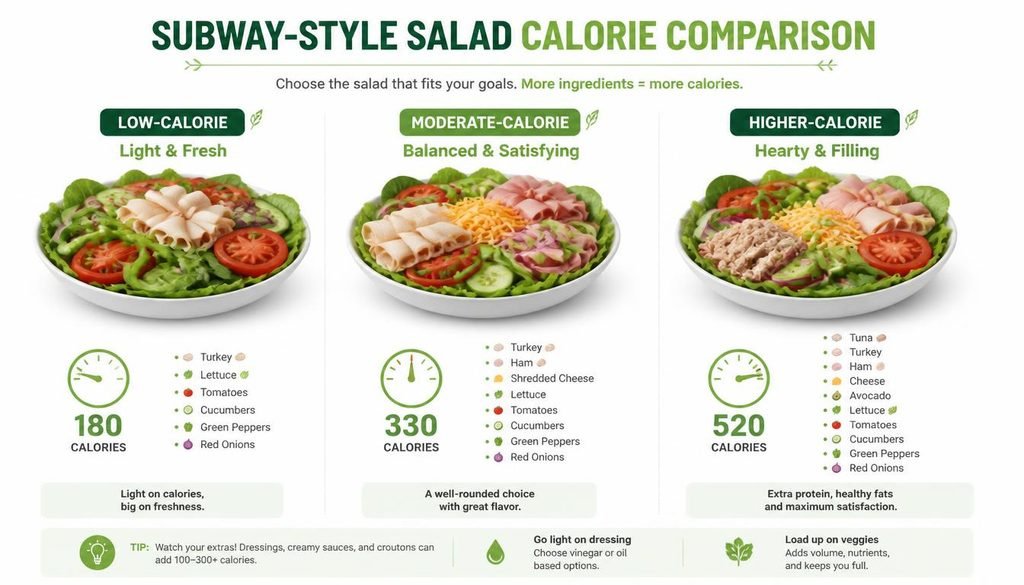
For example, current Subway U.S. menu data lists the Veggie Delite® salad at 140 calories, the Subway Club® salad at 240 calories, the Tuna salad at 400 calories, and the Oven-Roasted Turkey salad at 420 calories. Other choices, such as the Honey Mustard salad, can reach 480 calories.
This guide explains Subway salad calories, nutrition, toppings, dressings, and simple ways to build a salad that fits your needs.
Table of Contents
What Is Subway Salad Calories & Nutrition Guide?
The Subway Salad Calories & Nutrition Guide is a way to understand how many calories and nutrients are in a Subway salad and its ingredients.
Unlike a fixed homemade salad, a Subway salad can be customized. You can choose different proteins, cheeses, vegetables, sauces, and extras. Each choice changes the total nutrition.
Subway’s U.S. nutrition information shows that salad calories are not the same for every menu item. For example, the current menu lists:
| Subway Salad | Calories | Protein | Fiber |
|---|---|---|---|
| Veggie Delite® | 140 | 9 g | 4 g |
| Subway Club® | 240 | 24 g | 4 g |
| Tuna | 400 | 21 g | 4 g |
| Oven-Roasted Turkey | 420 | 24 g | 4 g |
| Black Forest Ham | 430 | 23 g | 4 g |
| Turkey & Ham | 410 | 20 g | 4 g |
| Honey Mustard | 480 | 31 g | 5 g |
These figures are from current Subway U.S. menu pages and can vary with location and menu availability.
That means there is no single answer to the question, “How many calories are in a Subway salad?” The answer depends on what is in the bowl.
How Does Subway Salad Nutrition Work?
Subway salads are built from several parts. The final calorie count is the total of the ingredients in your bowl.
The Base Matters
The salad base usually includes lettuce and spinach. These vegetables add volume without contributing as many calories as high-fat toppings or sauces.
Vegetables can also make a salad feel larger and more satisfying because they add food volume and fiber.
Protein Changes the Nutrition
Protein is one of the most important parts of a filling salad. Subway offers salad options with meats such as turkey, ham, roast beef, chicken, and tuna, depending on the restaurant and current menu.
For example, Subway’s current menu lists the Subway Club salad at 240 calories with 24 grams of protein, while the Tuna salad is listed at 400 calories with 21 grams of protein.
Protein can make a salad more substantial, but the total calories also depend on the other ingredients.
Cheese Adds Calories
Cheese is a small-looking topping that can make a noticeable difference.
Current Subway U.S. menu data lists individual cheese portions at approximately:
- American cheese: 80 calories
- Provolone: 90 calories
- Pepper Jack: 98 calories
- Monterey Cheddar: 109 calories
These values are shown on current Subway restaurant menu pages.
If your salad already contains a calorie-dense protein and dressing, adding cheese can raise the total further.
Sauces Can Change the Total Quickly
Sauce is often the easiest part of a salad to overlook.
Current Subway menu information lists examples such as:
- Red Wine Vinegar: 0 calories
- Yellow Mustard: 20 calories
- Sweet Onion Teriyaki: 56 calories
- Creamy Sriracha: 76 calories
- Honey Mustard: 118 calories
- MVP Parmesan Vinaigrette™: 121 calories
- Baja Chipotle: 137 calories
- Peppercorn Ranch: 155 calories
- Roasted Garlic Aioli: 160 calories
The exact serving size and available sauces can vary by location, so check the nutrition information for your restaurant.
Benefits of Subway Salads
A Subway salad can be a useful meal choice because you have control over many of the ingredients.
Benefit 1: You Can Add Plenty of Vegetables
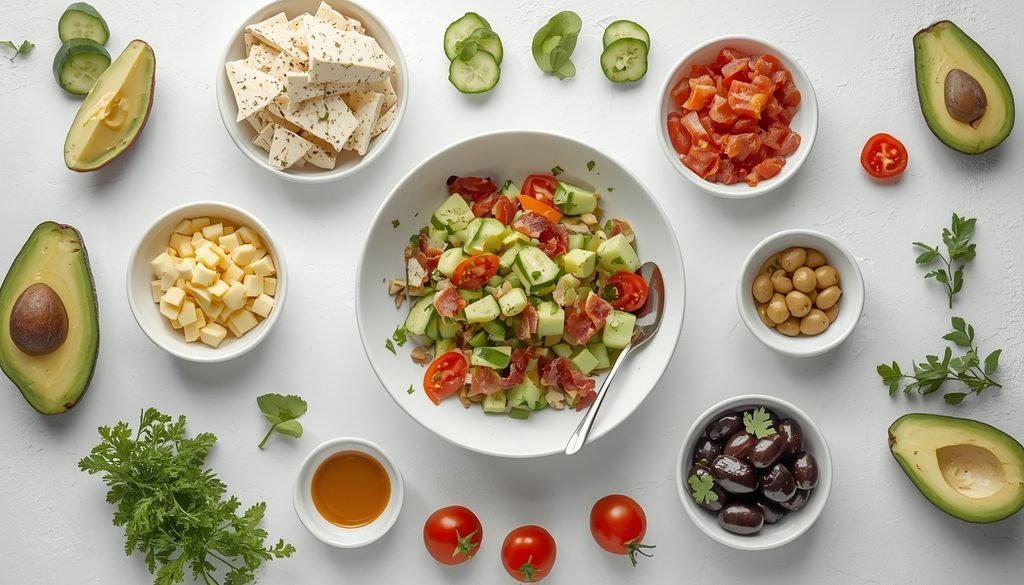
A salad lets you add several vegetables in one meal. Subway’s salad builds can include ingredients such as tomatoes, cucumbers, peppers, olives, onions, and spinach.
Adding vegetables can give your meal more texture, color, and volume.
Benefit 2: You Can Choose a Protein Source
Protein can make a salad more filling than a bowl made mostly from vegetables.
For example, Subway’s current menu lists the Subway Club salad at 24 grams of protein and the Oven-Roasted Turkey salad at 24 grams.
Choosing a protein-based salad may be helpful when you want a meal rather than a light side.
Benefit 3: You Control the Toppings
One of the biggest advantages of a Subway salad is customization.
You can decide how much cheese, avocado, bacon, and sauce to add. This gives you more control over total calories than choosing a meal without customization.
For example, Subway currently lists bacon at 80 calories, sliced avocado at 91 calories, and smashed avocado at 70 calories on some U.S. restaurant menus.
How to Build a Subway Salad
Building a salad with your nutrition goal in mind does not have to be difficult.
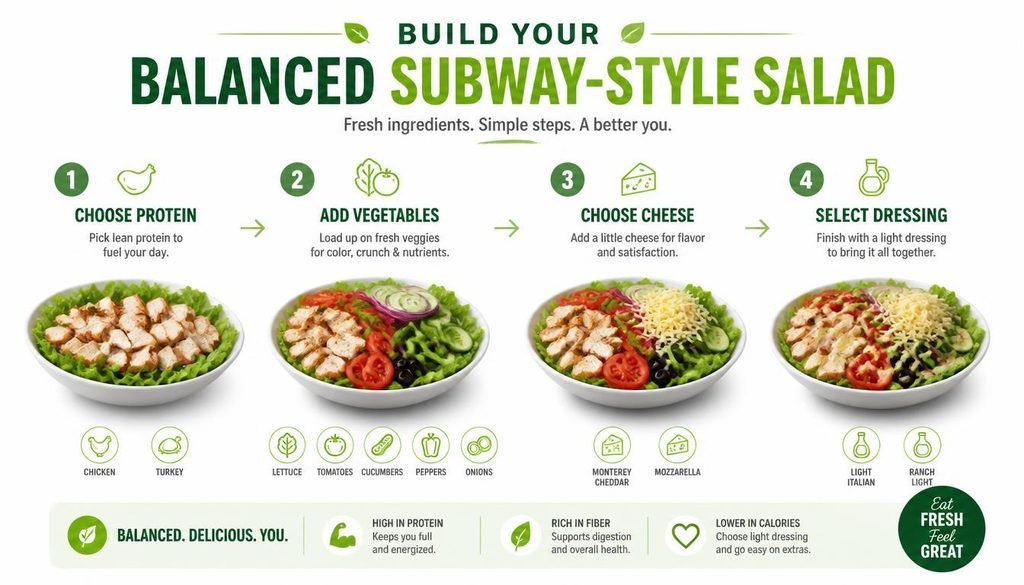
Step 1: Choose Your Protein
Start by deciding whether you want meat, tuna, or a vegetable-based salad.
A protein choice can make the salad more satisfying. At the same time, check the listed calories because different menu items can vary significantly.
For example, the current U.S. menu lists the Subway Club salad at 240 calories, while the Black Forest Ham salad is listed at 430 calories.
Step 2: Add Vegetables
Load up on the vegetables you enjoy.
Tomatoes, cucumbers, peppers, onions, olives, and spinach are common ingredients in Subway salad builds.
Vegetables can help make a salad look and feel more generous without relying only on cheese or dressing.
Step 3: Pick Cheese and Sauce Carefully
Next, decide whether you need cheese and what type of dressing you want.
Cheese is optional, and sauce can make a large difference in total calories. For a lighter option, you can choose a lower-calorie sauce or ask for less dressing.
Always remember that “salad” does not automatically mean “low calorie.” A salad with cheese, avocado, bacon, and a creamy sauce can become much more calorie-dense.
Practical Examples
The examples below are for understanding how ingredient choices affect a meal. They are not personal diet recommendations.
Example 1: A Lighter Vegetable Salad
Suppose you choose the Veggie Delite® salad listed by Subway at 140 calories, with its standard vegetables and cheese. The current menu lists 9 grams of protein and 4 grams of fiber for this salad.
Now imagine adding a 118-calorie Honey Mustard sauce. That would add 118 calories to the base value, bringing the simple total to about 258 calories, assuming the same listed serving sizes.
This shows why checking the dressing matters.
Example 2: A Higher-Protein Salad
The Subway Club® salad is currently listed at 240 calories and 24 grams of protein. It includes turkey, ham, roast beef, American cheese, tomatoes, cucumbers, peppers, olives, onions, and a lettuce-and-spinach base.
Adding an extra calorie-containing sauce or topping would increase the total.
The key lesson is simple: start with the menu item’s listed nutrition, then add the calories from extras.
Common Mistakes
Even a salad can become much higher in calories when toppings are added without checking their nutrition.
Mistake 1: Assuming Every Salad Is Low in Calories
The word “salad” describes the type of meal, not a calorie limit.
Current Subway menu listings show salads ranging from 140 calories for Veggie Delite® to 480 calories for Honey Mustard, before considering additional customization.
So it is better to check the actual menu nutrition instead of guessing.
Mistake 2: Forgetting About the Dressing
Dressing can be one of the biggest contributors to calories.
For example, Subway lists Red Wine Vinegar at 0 calories, Yellow Mustard at 20 calories, Honey Mustard at 118 calories, and Roasted Garlic Aioli at 160 calories on a current U.S. menu page.
Two salads with the same vegetables can therefore have very different calorie totals.
Mistake 3: Adding Several Calorie-Dense Toppings
Cheese, bacon, avocado, and sauces can all add calories.
A current Subway menu page lists bacon at 80 calories, sliced avocado at 91 calories, and smashed avocado at 70 calories.
Adding several extras can quickly change the nutrition of your meal.
Mistake 4: Ignoring Location Differences
Subway menus and nutrition information can differ by country, region, restaurant, and time.
Subway’s official nutrition page provides separate U.S. nutrition information, while its international sites can list different products and nutrition values.
For the most accurate number, use the nutrition information for the specific Subway location where you are ordering.
Tips and Best Practices
Use these simple ideas when checking Subway salad nutrition.
Start with the full salad. Do not look only at the meat or vegetables. The listed calorie number often includes the standard build.
Check the sauce. This is one of the easiest ways to change the total calorie count.
Add vegetables freely within your preferences. Common salad vegetables can add volume and variety.
Watch the extras. Cheese, bacon, avocado, and creamy sauces can add meaningful calories.
Look at protein, too. Calories are only one part of nutrition. Current Subway menu pages list protein and fiber for many salads, making it easier to compare options.
Use the official Subway nutrition information. Menu items change, and restaurant menus can vary. Subway’s official nutrition page links to its U.S. nutrition tables and ingredient information.
Do not treat calorie numbers as personal medical advice. Your calorie needs depend on many factors, including age, body size, activity, and health goals.
Frequently Asked Questions
What is Subway Salad Calories & Nutrition Guide?
The Subway Salad Calories & Nutrition Guide explains the calories, protein, fiber, and other nutrition information in Subway salads and their ingredients. It also helps you understand how toppings, cheese, sauces, and other customizations change the total.
How does Subway Salad Calories & Nutrition Guide work?
You start with the nutrition value listed for the salad you choose, then consider any added ingredients. The final total depends on your protein, vegetables, cheese, sauces, and extras.
Why is Subway Salad Calories & Nutrition Guide important?
It helps you make a more informed choice instead of assuming every salad has the same calorie count. Subway’s current U.S. menu shows a wide range of salad calories, so checking the actual item is useful.
What are the benefits of Subway Salad Calories & Nutrition Guide?
The guide makes it easier to compare menu items, understand protein and fiber amounts, and see how toppings affect calories. It can also help you customize a salad based on your own food preferences and goals.
What are common mistakes?
The most common mistakes are assuming every salad is low in calories, forgetting about dressing, and adding several calorie-dense toppings without checking their nutrition. It is also easy to use outdated information when menu items change.
How many calories are in a Subway salad?
There is no single calorie number because Subway offers different salads and customizations. Current U.S. listings include 140 calories for Veggie Delite®, 240 for Subway Club®, 400 for Tuna, 420 for Oven-Roasted Turkey, 430 for Black Forest Ham, and 480 for Honey Mustard.
What is the lowest-calorie Subway salad?
Among the current U.S. salad listings checked for this guide, Veggie Delite® is listed at 140 calories. The exact menu and availability can vary by restaurant.
Are Subway salads healthy?
A Subway salad can fit into a balanced eating pattern, but “healthy” depends on the full meal and your individual needs. Ingredients such as vegetables can add fiber and volume, while sauces, cheese, and other extras can increase calories, fat, or sodium.
Does Subway salad have protein?
Yes. Many Subway salads contain protein from ingredients such as turkey, ham, roast beef, chicken, or tuna. For example, the current Subway Club salad lists 24 grams of protein, while the Oven-Roasted Turkey salad lists 24 grams.
Can I make a Subway salad lower in calories?
You can change the calorie content by choosing different proteins, limiting calorie-dense toppings, and selecting a lower-calorie dressing. Subway’s menu lets you customize ingredients, so the exact total depends on what you order.
Conclusion
The Subway Salad Calories & Nutrition Guide shows that Subway salads can vary widely in calories and nutrition. A Veggie Delite® salad is currently listed at 140 calories, while other salads can range into the 400-calorie range before extra customization.
The biggest factors to watch are protein choices, cheese, avocado, bacon, and especially sauces. For an accurate count, check the official Subway nutrition information for your location and include the toppings and dressing you actually order. Subway itself notes that a 2,000-calorie daily value is used for general nutrition advice, while individual calorie needs vary.